In this post on the what is Fragrance Wheel and Olfactory Families, we will discuss the famous fragrance wheel
Aside from the olfactory pyramid, an additional instant and useful
tool for bettering and/or writing your personal perfumes is your
Fragrance Wheel. The Most Recent version of this Fragrance Wheel dates
back To 1992 and can be credited to the odour historian and taxonomist
Michael Edwards, an authority from the perfume industry. His guidebooks and guides such as”Fragrances of the world”
Though every cologne differs from others, distinct fragrances share common traits which relate them to a distinct olfactory family.
Citrus or Hesperidic, composed of Mediterranean notes, including lemon, bergamot, tangerin, orange, lavender, lime and strawberry.
What Is A Fragrance Wheel?

Olfactive households aren’t a way for categorising components however the notes, that are descriptors of scents. In essence, it was a strategy to break down and sophistication how a fragrance smells relatively than what it accommodates. As strategies for synthesising compounds turned extra elaborate within the late 19th Century, so did strategies for categorising them. The first conventional classification of fragrances emerged round 1900 with 7 households.
However, by 1945 it turned obvious that this model was far too primitive with the technological advances in compound design. In 1949, Austrian perfumer Paul Jellinek devised the primary perfume wheel. A perfume wheel works for essentially the most half by illustrating the connection between olfactory teams primarily based on similarity or variations. It serves as visible support not just for figuring out perfumes but additionally in creating new compounds. In 1983, legendary fragrance taxonomist Michael Edwards then rebuilt the perfume wheel from the bottom up. The Michael Edwards Fragrance Wheel was wildly profitable and since went on to be a trade commonplace. Oenologists or skilled wine tasters have even been identified to make use of the perfume wheel when figuring out fragrant compounds in wine. Edwards has modified and honed his perfume wheel quite a lot of times to turn out to be extra streamlined. The newest 2010 revision contains 4 commonplace households (Floral, Oriental, Woody and Fresh), that are divided into three or 4 subgroups.
The Bespoke Unit Fragrance Wheel
Understanding the trade’s varied perfume wheels will be notably
overwhelming for each novice and fans alike. Traditional households akin
to Fougère are sometimes liquidated and dispersed amongst newer,
broader households. Wheels can range from so complicated that they’re
exhausting to know or overly easy that households really feel noticeably
absent. For this cause, Bespoke Unit has developed its personal
Fragrance Wheel. It endeavours to stroll the nice line between
comprehensiveness and comprehension. The total goal is to be welcoming
to newcomers while performing as an invaluable useful resource to
current fans.  The wheel consists of two easy dividing teams, that are recent and
heat. These are then cut up the eight olfactive households that we now
have outlined throughout a discernable spectrum. The eight households
are then organized by their relationship with each other. For instance,
Woody and Oriental share sure dry and powdery traits.
The wheel consists of two easy dividing teams, that are recent and
heat. These are then cut up the eight olfactive households that we now
have outlined throughout a discernable spectrum. The eight households
are then organized by their relationship with each other. For instance,
Woody and Oriental share sure dry and powdery traits.
Their properties are sometimes used to plan Leather fragrances, which is a bunch discovered between them. Both the Woody and Chypre households act as tangible Fresh/Warm divides. Chypres are totally identified for his or her characteristically heat moss bases, which sharply distinction with their recent citrus heads. Conversely, woody fragrances can range from recent pines to deep cedar bases.
A perfume wheel is the beginning block, which then permits the person to delve even additional by exploring the recognized household in a larger element. Of course, like all perfume wheel, there are exceptions to the foundations laid out. For occasion, every household consists of its personal subdivisions or subfamilies. Although the perfume belongs to a dominant household, it could share properties from others. In sticking to musical vocabulary, this method of mixing notes known as an accord.
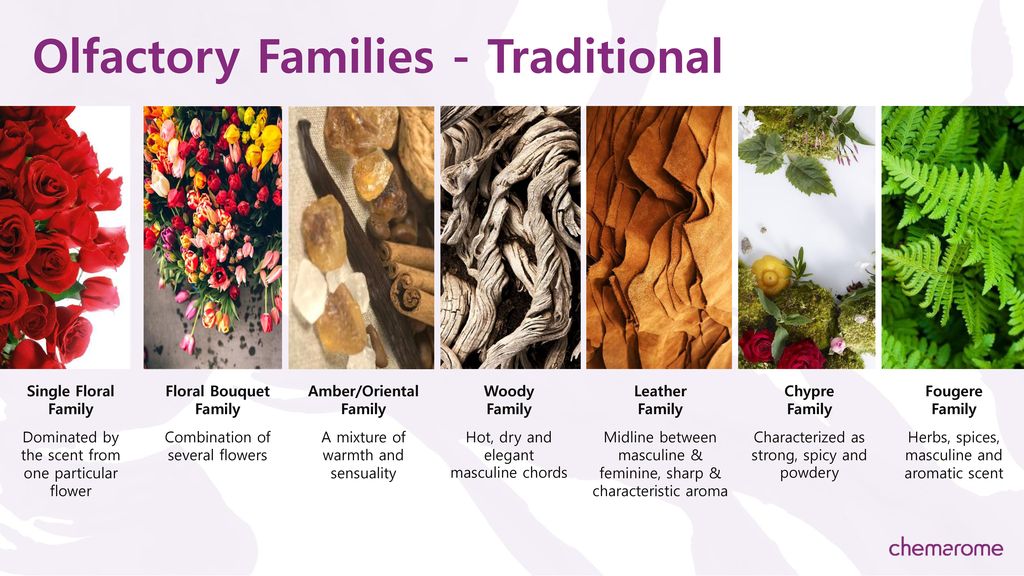
Floral.
These scents can be pulled from one blossom or by a bouquet of different flowers.
Woody:
hot and extreme Fragrances mostly for guys (female aromas blend woody
notes with floral or citrus ones) that odour of soft or dry woods such
as cedarwood, vetiver
and sandalwood.
Fougère:
manly scents named It features warm woody and somewhat floral notes, using a foundation of lavender, geranium, vetiver, oakmoss and coumarin plus a new citrus dash to secure more lively compositions.
Like Fougère, this household is called after the cologne made in 1917 by François Coty. The objective of the French master perfumer was supposed to recreate the air of this island of Cyprus, a lavish vacation destination and an area of import of oakmoss.
In reality, that is one of those fundamental ingredients of Chypre scents, together with labdanum, patchouli, bergamot and floral notes such as lavender or rose.
Vanilla, musk, amber and spices: a household of sensual female and male fragrances that reminds oriental and exotic atmospheres.
These are dry and intense notes of tobacco and leather, frequently utilised together with floral mind notes.
Aromatic:
new fragrances mostly for guys, that remember natural atmospheres from the open air. The principal ingredients, in reality, comprise Mediterranean aromatic herbs such as rosemary, lavender and lavender, but also slightly spicy notes like peppermint, anise and red tea, which perfectly blend with marine notes to get a more lively effect.
Different olfactory households, highlighting their common things in an easy and immediate manner.
According to Edwards, fragrances can be split into four chief
categories: flowery, oriental, refreshing and woody. Since every
category is divided into additional subcategories,
We can differentiate 14 overall olfactory households, different from one
another for a particular olfactive tone.
More can be read at
https://perfumelead.com/what-is-fragrance-wheel-and-olfactory-families/
Comments
Post a Comment